



A Guide to Wood Substrates: Northeastern U.S. Tree Species
 April 28, 2026
 The Northeastern U.S. is home to a flourishing horticulture industry that has historically sourced most of its growing media from either the Southern U.S. or Canada. The availability of wood fiber products in the region has been limited to one or two producers from outside the Northeast. At the same time, the region is home to an abundance of conifer tree species that, until recently, had not been investigated for their potential to produce wood fiber.
As part of broader efforts to explore regional tree species across the U.S. as potential feedstocks for growing media, private and public research initiatives have investigated several native tree species over the last four years. Among them, white pine (Pinus strobus), red pine (Pinus resinosa), and Canadian/Eastern hemlock (Tsuga canadensis) have shown promise.
White pine was first investigated in 2005 by researchers at Virginia Tech, who concluded that the species could be used successfully as a component in peat- or pine bark-based substrates for crop production. At that time, however, interest in the commercialization of wood fiber was limited, and no further work was pursued. By 2022, that had changed as more growers adopted wood products in their growing media portfolios, increasing interest in regionally available tree species for the sourcing and production of wood fiber substrates.
Commercial Production and Trialing Begin
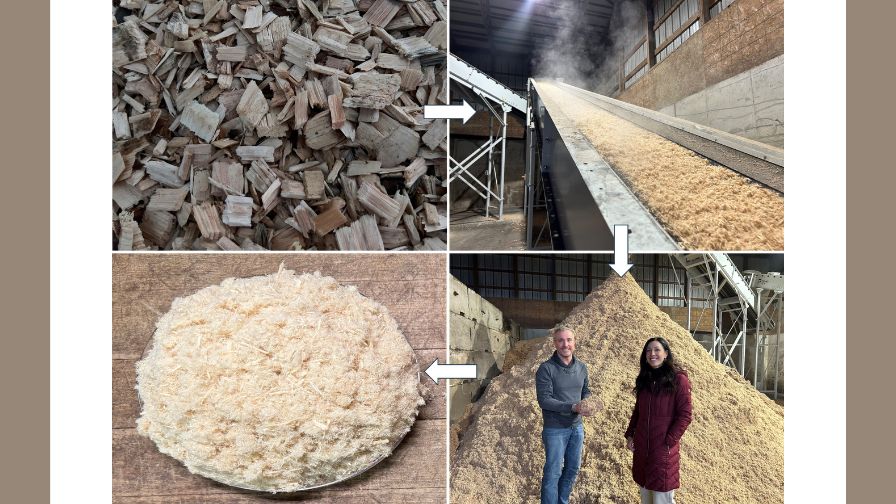
Figure 1. White pine chips being extruded into wood fiber growing media at P.R. Russell in Brentwood, NH. | Brian Jackson
The first commercial production of wood fiber from white pine trees began in November 2022 at P.R. Russell, a mulch and soil company in Brentwood, NH (Fig. 1).
To produce fiber, the company installed a commercially available extruder system that can be configured to produce a range of fiber sizes for different substrate applications. In partnership with P.R. Russell, experiments were conducted at North Carolina State University in spring 2025 to compare extruded wood fiber with hammer-milled wood substrates.
White pine trees were harvested and chipped in New Hampshire, then transported to the P.R. Russell production site, where the fresh wood chips were processed through the extruder. The resulting fiber was bagged in storage totes and shipped to North Carolina. Super sacks of the same fresh wood chips were also sent to NC State. Upon arrival at the Substrate Processing and Research Center, the chips were processed through a hammer mill to produce a substrate-grade material, which was then stored in super sacks alongside the extruded fiber under an open-air shelter.
This was the first investigation to compare wood chips processed by two different methods as part of a broader research initiative to quantify differences in the physical and chemical properties of wood fiber, as well as performance when used as a growing media component.
The extruded and milled white pine substrates were incorporated with peat at various ratios, 20%, 40%, and 60% by volume, immediately after processing to create mixes for analytical testing and greenhouse plant growth trials. The trials were repeated after 45 days of substrate storage and again after 90 days to determine whether storage time influenced material properties or plant growth performance.
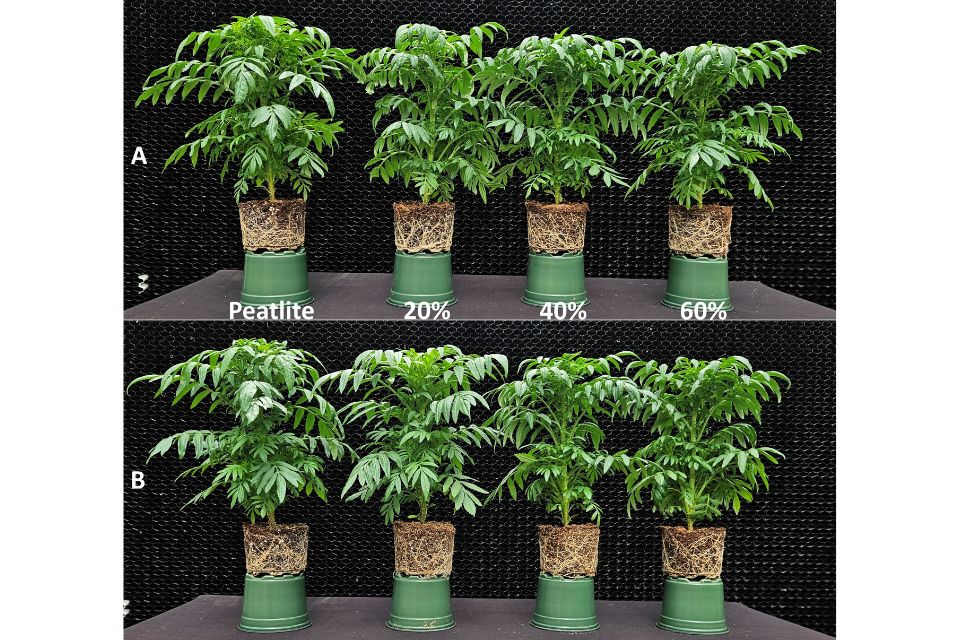
Figure 2. Marigolds grown in peatlite and three rates of A) extruded and B) hammer-milled white pine wood. | Brian Jackson
Results showed no difference in plant growth (dry weight) among wood types (extruded or milled), wood incorporation rates, or storage time, compared to plants grown in the peatlite controls (Fig. 2). During the growth trials, fertility and irrigation were applied equally across all treatments. These replicated trials provided strong evidence that white pine-derived wood substrates can be used successfully in greenhouse crop production.
It is believed that the proportion of peat moss in the experimental mixes, even at levels as low as 40%, was a major contributor to the positive plant growth observed with up to 60% wood amendment. Peat is well known as an effective “enabler” in wood substrates because it can help mitigate phytotoxicity while improving water-holding capacity and nutrient retention.
Trials with other conifer species, including red pine and hemlock, were also conducted between 2023 and 2025. These species were sourced, milled, and tested in ways similar to the white pine trials. Some of the greenhouse trials included 100% wood substrates to further explore the potential of wood as a sole-source substrate. Although that is not currently a common industry practice, trials using 100% wood substrates have been reported numerous times over the past 20 years.
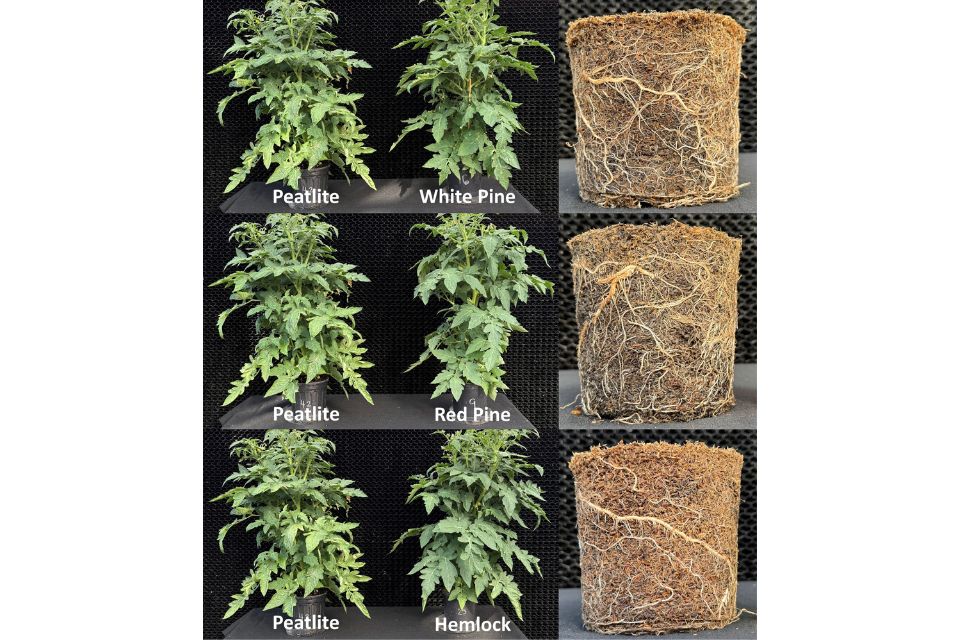
Figure 3. Tomatoes grown in peatlite or 100% hammer-milled wood derived from three Northeast conifer species. | Brian Jackson
As discussed in previous articles in this series, wood substrates produced in hammer mills have different properties than those produced in screw extruder or disc refining systems. Hammer-milled wood is not a true fiber and has particle shape, consistency, and density more similar to bark. As a result, it does not clump, bridge, or shrink when used as a loose-fill substrate in containers at 100%, unlike extruded or refined fibers.
Tomato growth trials conducted in 2025 were carried out for 10 weeks in 1-gallon plastic pots using red pine, white pine, and hemlock, among several other wood species. Fertility (200 ppm N) and irrigation were similar across all substrate treatments. Results showed similar plant growth in all wood species compared to plants grown in the peatlite control (Fig. 3). Previous trials had shown reduced growth across numerous annual species in these 100% wood substrates when the material was fresh, but the wood substrates used in this tomato trial had been stored for more than one year. We hypothesize that the extended storage time outdoors under shelter reduced the wood extractives, or phytotoxins, that had previously caused growth reductions. It remains unclear why nitrogen immobilization, which typically occurs and can reduce plant growth, did not appear to be prohibitive in this trial. These results have promoted further research into the effects of aging on wood substrate quality and performance.

In case you missed any of them, make sure to check out Parts 1, 2, 3, 4, and 5 in this series covering wood substrates.
Subscribe to eNewsletter